
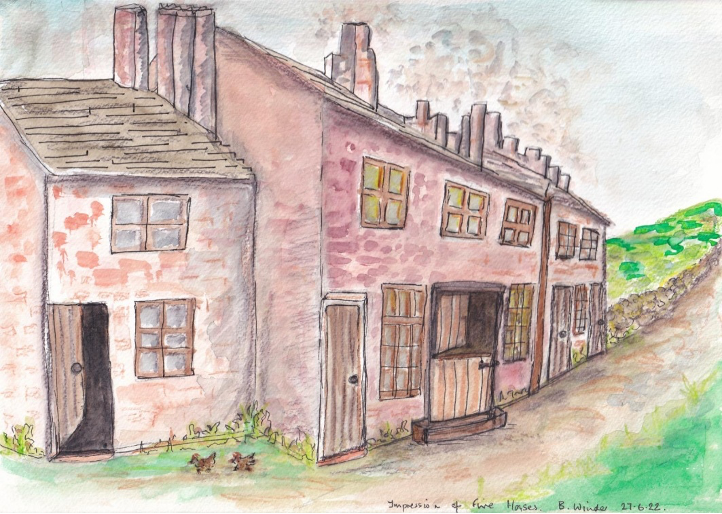
Going up Winter Hill Road, towards its summit, on the left hand side, there was a group of terraced houses. Nothing remains today apart from a layby and a bank separating the houses from the brick works. This was Five Houses, probably constructed of locally made red brick, which was unusual; miners’ cottages were usually stone built. They were probably demolished in the early 1900s, after being used for around 50 years, but in its later years they probably acted as a store house for the works, and were no longer a home for families.
Five Houses was built by William Garbutt, a businessman from a large Shropshire family, who moved to Lancashire with his wife, brother and nephew. He developed a farm, Coal Pits Brick works and built the terrace of houses for his employees, and probably Hole Bottom bungalow nearby. The houses were so synonymous with him, the local people knew the area as Garbutt’s.
The 1841 census shows William and his wife Hannah living at Five Houses with his nephew Gabriel, 21, and gives William’s occupation as a coal master.
In the first house, according to the 41 census, lived Coal Miner Joseph Lomax (25) and his wife Sarah (35), and their daughters Alice, Betty and Mary (ages 14, 6 and 4). The Lomax family lived there until the cottages were abandoned. Next door is a boarding house. John Garner and William Finisher (both Agricultural labourers) stayed there, along with Samuel Benny (19) a Coal Miner; and all shared the house with Betty Holding, (52) of independent means. In the central probably biggest house is William Garbett (50) the Coal Master, with his wife Hannah (40). This was the Garbutts Ale House.
Adjoining Garbutts is another boarding dwelling, with Richard Unsworth, a 15 year old Coal Miner; Gabriel Garbett, William’s 21 year old nephew, also a Coal Master; William Halliwell (25) a Stone Mason and Thomas Heywood (60) a Coal Miner.
The fifth remaining house in the 41 census was the Whittle Family house, where at the time of the murder some three years earlier in 1838 lived the accused murderer Jamie Whittle, a miner. James lived there with his family- father, mother and sister Ruth, a laundress and brother Charles also a miner; all adults, all working in the area.
Most adults living there were either miners or agricultural labourers, the most common work found in the 41 census. Sarah Lomax, and Garbutt’s wife witnessed James Whittle crossing in front of their windows near the time of the murder as is said in the statements; which suggests he was in the area but not near the murder.
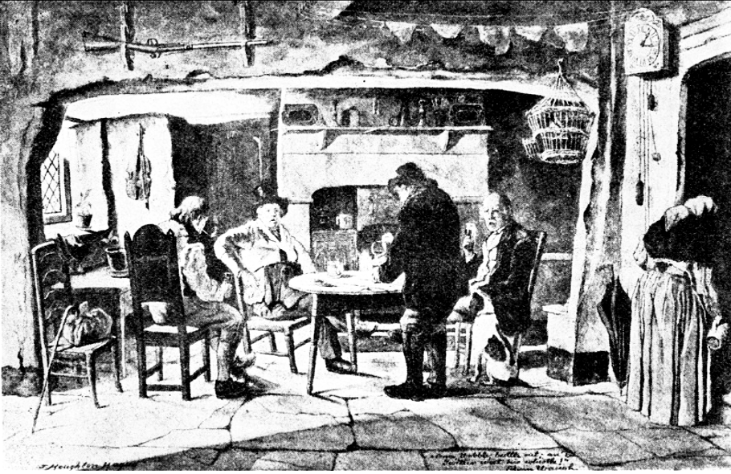
A beerhouse, was a new type of licensed premise for the sale of beer often brewed on site, within set licensing hours, though magistrate records in the local newspapers show the hours were not always adhered to. The beer was probably sold in jugs in the main sitting room with a big table. In November 1838 George Henderson had a glass of beer here before continuing his journey, as did his friend Burrell who was an hour ahead of him on the road, and later George’s gravely wounded body was brought to the beerhouse in Five Houses and placed on the table where he took two hours to die. It stayed there for a week whilst an autopsy took place and George’s sister visited, until it was taken in a coffin in procession to Blackburn by his employer. We are told Garbutt deliberately sold no beer during this period.
What facilities the houses had is difficult to judge. It’s doubtful they had running water though streams were nearby, and indoor bathrooms and toilets are highly unlikely even for the Garbutts.
I have suggested the ‘turf cess’ where one of the shooting party was captured hiding in suspicious circumstances after the murder may have part of the sanitary arrangements- certainly communal basic lavatories and laundries were common into the twentieth century for the working poor.
No doubt cooking was done on open fires, although some may have had a side or cooking fire range. Bedrooms may well have been communal and accessed by wall ladders rather than stairs. So in effect the houses may have been one up and one down. In 1910 my grandparents in Derbyshire had their 9 children all sleeping in a double bed- girls at the top and boys at the bottom. They had three bedrooms one for themselves and one for a lodger.
Next door had 13 children all similarly placed. We know the beerhouse had a stable door so people could stand outside as well as within. Many families may have had some livestock such as a pig and hens to supplement their diet, no doubt with some poaching of rabbits and birds. Vegetables were grown and possibly bartered. James Whittle’s father calls himself a farmer on documents, but probably had a little acreage on the bleak moorland.
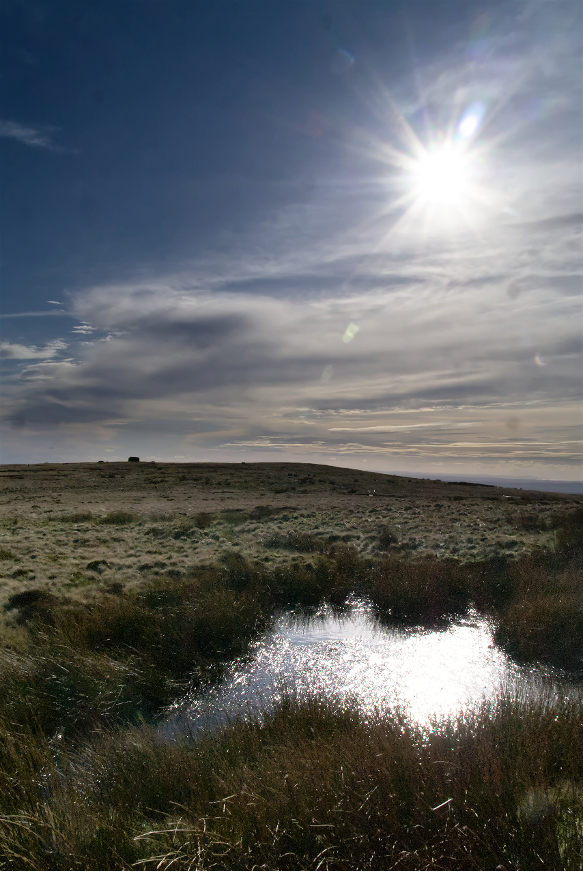
William Garbutt seems to have made a good living from his leases on Winter Hill. The Bolton Free Press of 16 Oct 1841 has a report on an extension of lease hearing in which he’s involved to lease land and a mine on Winter Hill. The lease was £3.15 a year and he paid at least £50 a year from his profits. Garbutt had some authority in the hill community- he was called Mr Garbutt by the other families, he was the one that had the killing reported to him and his advice sought, and when he told his colliers to hunt for the attackers, they did so and arrested the Smithills Hall shooting party. His authority lay somewhere between that of the landowner Peter Ainsworth and the ordinary workers on the moor. The Brick and Tile Works nearby seems to have existed for longer than Five Houses – it was sold in February 1870 including the colliery, for a 15 year lease after the bankruptcy of William Knight of Horwich.
Garbutt sold the Brick Works in 1849 shortly before his death. although his nephew Gabriel, became the manager. Gabriel, his wife Mary and two young sons were by then living at Hole Bottom nearby. There is a mention of Five Houses in the 1861 census but by then the returns officer may be referring to Hole Bottom as both names are used in 1851 for the same place. It is possible Hole Bottom with two cottages was built at the same time by Garbutt.
Five Houses can be seen on maps of the period and were still referred to in local newspaper accounts in the early 1900s (`The party proceeded by way of Five Houses and Winter Hill gate to Church School at Belmont for a welcome tea`- Bolton Evening News 27 July 1903).